Pearson Edexcel · A-Level · Economics B
Course version: 9EB0 · Version from Sept 2015
Business regulation: d) The work of the Competition and Markets Authority
The Competition and Markets Authority (CMA) is the UK's independent competition and consumer authority.
Checked against the Pearson Edexcel 9EB0 specification (opens in a new tab) on .
- Point 4 of 5
- 2 key terms
Study notes
From the checked teaching notes for this specification point.
The idea
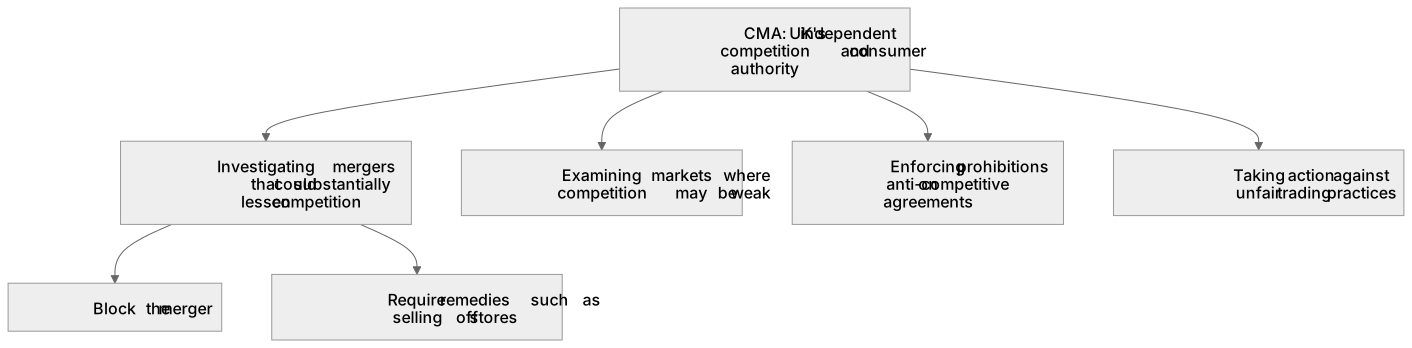
The Competition and Markets Authority (CMA) is the UK's independent competition and consumer authority. Its work covers investigating mergers that could substantially lessen competition, examining markets where competition may be weak, enforcing prohibitions on anti-competitive agreements, and taking action against unfair trading practices. For example, if two large supermarket chains proposed a merger, the CMA could examine whether the merged firm would control enough of the market to raise prices. It could block the merger or require remedies such as selling off stores. Understanding its powers helps explain how UK business regulation aims to protect consumers and maintain competitive markets.
What earns the marks
- Identify the CMA as the UK's independent competition and consumer authority responsible for promoting competition.
- Explain that the CMA investigates mergers that may substantially lessen competition and can block them or require remedies.
- Describe the CMA's role in conducting market studies and market investigations where competition may be weak.
- Outline the CMA's enforcement of prohibitions on anti-competitive agreements and abuse of dominance, including prosecuting criminal cartel offences.
Common mistakes and how to put them right
Misunderstanding: the CMA sets prices for all UK businesses.
Put it right: The CMA does not set prices; it investigates and remedies anti-competitive behaviour and mergers.
Misunderstanding: the CMA only deals with consumer complaints.
Put it right: Its remit includes competition enforcement, merger control and market investigations as well as consumer protection.
Misunderstanding: the CMA is part of the UK government and takes political direction.
Put it right: The CMA is an independent non-ministerial department that makes its own decisions based on economic evidence.
Exam tips
- Read the question carefully to distinguish between the CMA's competition powers and its consumer protection role.
- Use specific examples of CMA actions, such as blocking a merger or fining a cartel, to illustrate its work.
- Remember that the CMA operates independently and its decisions are based on evidence and legal tests, not political preference.
Try the lesson
The start of the Business regulation: d) The work of the Competition and Markets Authority lesson, made from checked teaching notes for this specification point.
Have a go first
What is one of the primary roles of the Competition and Markets Authority (CMA) in the UK?
Listen
The Competition and Markets Authority (CMA) is the UK's independent competition and consumer authority. Its work covers investigating mergers that could substantially lessen competition, examining markets where competition may be weak, enforcing prohibitions on anti-competitive agreements, and taking action against unfair trading practices. For example, if two large supermarket chains proposed a merger, the CMA could examine whether the merged firm would control enough of the market to raise prices. It could block the merger or require remedies such as selling off stores. Understanding its powers helps explain how UK business regulation aims to protect consumers and maintain competitive markets. A strong answer earns marks for these points. Identify the CMA as the UK's independent competition and consumer authority responsible for promoting competition. Explain that the CMA investigates mergers that may substantially lessen competition and can block them or require remedies. Describe the CMA's role in conducting market studies and market investigations where competition may be weak. Outline the CMA's enforcement of prohibitions on anti-competitive agreements and abuse of dominance, including prosecuting criminal cartel offences. A common slip: Misunderstanding: the CMA sets prices for all UK businesses. Instead, the CMA does not set prices; it investigates and remedies anti-competitive behaviour and mergers. Exam tip: Read the question carefully to distinguish between the CMA's competition powers and its consumer protection role.
See it
Key words
Say what each word means before you turn the card.
Consumer protection
Try answering aloud or in your head before turning the card.
Market power
Try answering aloud or in your head before turning the card.
See every definition
- Consumer protection
- Part of the Competition and Markets Authority's remit, alongside competition enforcement, merger control and market investigations, which includes taking action against unfair trading practices.
- Market power
- Control of enough of a market for a merged firm to raise prices, which the Competition and Markets Authority examines when two large firms propose a merger.
Label the diagram
Some boxes have lost their names. Pick the right name for each number.
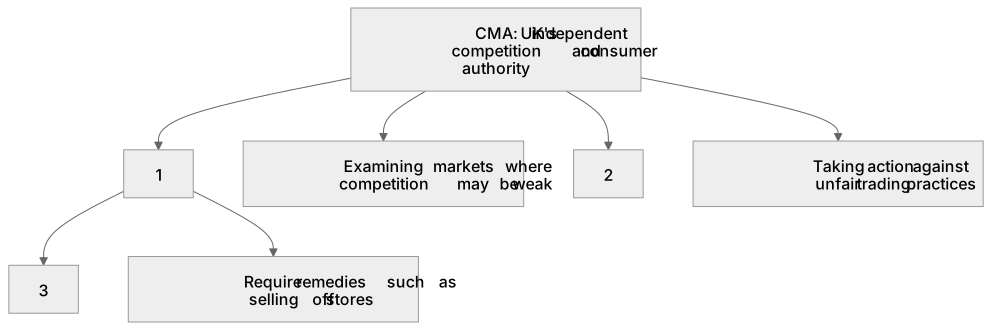
1Box 1
2Box 2
3Box 3
There is more to this lesson
The full lesson goes on to check your understanding and help you earn the marks. Create a free account to carry on, with your progress saved.
A week of Premium from your first lesson · Then the free plan continues · No card, no charge
Test your understanding of Business regulation: d) The work of the Competition and Markets Authority
Active recall beats re-reading. Take an instant quiz now to test what you’ve learned and lock it into long-term memory.
A week of Premium from your first lesson · Then the free plan continues · No card, no charge